ENVIRONMENT | MARINE LIFE Introduction
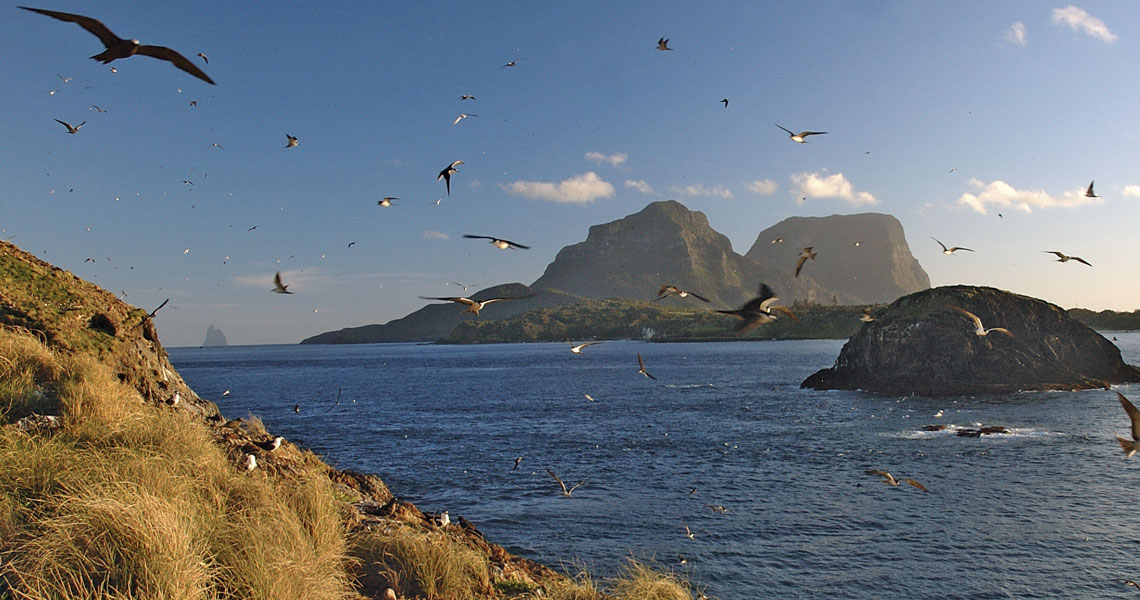
Lord Howe Island is a marine paradise. The spectacular mountain scenery, clear oceanic water, and brilliantly coloured coral reefs make this beautiful marine environment unforgettable. The marine communities at Lord Howe Island (LHI) are globally unique, and contain thousands of tropical, subtropical and temperate species, including some endemic species that are found nowhere else. The global significance of LHI and the marine environment is highlighted by its inclusion on the World Heritage List, and the declaration of the Lord Howe Island Marine Park in 1999. There are diverse marine habitats to explore, and because of the small human population, the marine environment at Lord Howe Island is relatively pristine.
 
Learn More About The Marine Life Of Lord Howe Island
| FORAMS - Phylum Foraminifera |
 |
| FORAMS - Phylum Foraminifera |
 |
Forams are single celled organisms that secrete a calcium carbonate shell, which makes identification easy. The shell is perforated and a jelly like protoplasm extends in and around the shell; this protoplasm is used to gather food and for mobility. On Lord Howe Island, the most conspicuous is Marginopera vertebralis, which can have the form of a small white disc 6mm in diameter, found on the sandy seashore and lagoon floor. The shells can contribute calcium carbonate material to the sand of the beaches and lagoon. |
|

|
| SPONGES - Phylum Porifera |
 |
| SPONGES - Phylum Porifera |
 |
Sponges are the simplest form of multi-cellular animal life. Often overlooked, they are an important component of reef systems and other marine habitats. Sponges are the filters of the sea, filtering the water as they pump it through a complex system of canals in their bodies, to collect small bacteria and particles of organic debris for food. Water circulation inside the sponge is achieved by the beating action of millions of tiny whip-like flagella on cells that line the canals. Sponges are generally hermaphrodites and can reproduce sexually through the production of swimming larvae that are released into the water via their outlet canals. The larvae later settle onto a substratum and grow to form an adult. Sponges may also reproduce asexually, via buds that break off the parent and develop into new adults. Small pieces of sponge detached during storms may also reattach and grow again. |
|

|
| CORALS, ANEMONES AND JELLYFISH - Phylum Cnidaria |
 |
| CORALS, ANEMONES AND JELLYFISH - Phylum Cnidaria |
 |
These are a diverse group of invertebrate animals that all possess stinging nematocysts - they include jellyfish, Bluebottles, anemones and corals.
Reef-building corals are the most conspicuous cnidarians you will see at Lord Howe Island. These corals extract calcium, carbon and oxygen from their marine environment, and combine these elements into a rigid, hard skeleton of calcium carbonate. Soft corals are related to hard corals and often compete strongly with hard corals for space on reefs.
A coral colony grows by asexual budding to produce identical polyps, and the precise manner in which this takes place determines the coral's final shape, which can be encrusting, massive or branching.
Anemones are similar to corals but lack a hard skeleton, and can also reproduce asexually by budding into two individuals.
Corals, anemones and many other cnidarians also reproduce sexually, where eggs and sperm are released by hermaphrodite, female or male animals. After fertilisation occurs, a free-swimming planula larva develops, which eventually settles down onto the substratum and metamorphoses into a polyp form.
Other cnidarians such as jellyfish have a more complex life cycle involving distinct polyp and medusa phases. |
|


|
| FLATWORMS - Phylum Platyhelminthes |
 |
| FLATWORMS - Phylum Platyhelminthes |
 |
As the common name suggest, these worms have a very thin, flattened body that lacks segmentation. Many flatworms are parasites, while the free-living species include some marine groups that are brightly coloured and are often mistaken for nudibranchs (which are molluscs). Some of these conspicuous marine flatworms are several centimetres long and are often observed in rock pools gliding over the substratum, or swimming freely in the water. These flatworms are generally carnivores that feed on soft corals, bryozoans or other invertebrates. Flatworms have only one body opening that serves as both mouth and anus, and oxygen and carbon dioxide and other wastes diffuse through the thin body. Reproduction is sexual, with most flatworms being hermaphrodites that produce both eggs and sperm. |
|

|
| SEGMENTED WORMS - Phylum Annelida |
 |
| SEGMENTED WORMS - Phylum Annelida |
 |
Segmented worms are soft-bodied animals, and the largest group are the marine polychaete worms that have paddle-shaped projections and bundles of spines projecting from the body segments. Some polychaete worms move about freely on, or in, the seabed, or swim actively in the water. These worms usually have a well-developed head, with eyes, sensory tentacles and strong jaws that they use to capture prey. Other polychaetes are sedentary and live in tubes constructed from calcium carbonate, sand grains or secreted material. Many of these worms have specialised arrays of feeding tentacles that filter passing plankton and organic material from the water, whereas other species feed on organic material in the sediment. Polychaete worms reproduce sexually, producing eggs or sperm that may be shed into the sea for fertilisation, resulting in a planktonic larval stage. Other species brood their young in special chambers. |
| SEA MOSSES - Phylum Bryozoa |
 |
| SEA MOSSES - Phylum Bryozoa |
 |
Bryozoans are minute animals that form flat or branching colonies, often encrusting rocks or objects in the sea, giving them the common name 'sea mosses'. These small colonial creatures, although widespread in marine environments, are often overlooked, and only the larger conspicuous colonies are easily seen. The individual animals, called zooids, are only about 1mm long. The zooids live in a hard case, which protects their soft body parts. Although they lack a head, they feed via a crown of tentacles covered with hair-like cilia that draw food-laden water into their mouths. Not all zooids are feeders: some are modified for attachment, or protection, while others may be modified for the care of developing embryos. Bryozoan colonies grow by asexual budding of new zooids, while new colonies develop from larvae resulting from sexual reproduction. Zooids may be hermaphrodites, while some species have separate male or female zooids. |
|

|
| SNAILS, BIVALVES AND SQUID - Phylum Mollusca |
 |
| SNAILS, BIVALVES AND SQUID - Phylum Mollusca |
 |
Molluscs possess a soft body consisting of a head with sense organs, a muscular foot for creeping or digging, and a visceral mass comprising of the gut, reproductive and excretory organs. Most species possess a hard calcium carbonate shell, although in most cephalopods it is internal, and in slugs and octopuses the shell is reduced or absent. There are four main groups of molluscs:
Chitons (Class Polyplacophora) have a small, oval-shaped, flattened, bilaterally symmetrical body covered with eight overlapping calcareous shell plates. They can flex the body and fasten onto an uneven rock substratum using the strong muscular foot on the undersurface. Chitons feed on encrusting algae, sponges and bryozoans by scraping the surface with a long tongue-like radula. Females are generally triggered to deposit eggs externally after nearby males release sperm, although some species brood their young in the mantle cavity.
Snails and slugs (Class Gastropoda) are the most diverse group of molluscs and generally have a hard, spirally coiled calcium carbonate shell for protection (snails), although in opisthobranch sea slugs the shell is usually reduced or absent. Most are mobile grazers, feeding on a variety of algae and animals, but some groups are specialised carnivores or feed on detritus. Most groups have separate sexes although some are hermaphrodites. Some gastropods release eggs for external fertilisation, while other groups have internal fertilisation and attach numerous tiny eggs to the substratum in a jelly-like material. Some of the soft-bodied nudibranchs and other opisthobranchs are brightly coloured and patterned, serving as a warning to predators that they are toxic to eat.
Bivalves (Class Bivalvia) are a very diverse group of molluscs characterised by having two shells that enclose their laterally flattened body. The shells are joined at the margin by a ligament, and have hinged teeth. Two adductor muscles attached to the shells can close them tightly for protection, or to prevent desiccation. Most bivalves are filter feeders, pumping water across the highly modified gills to filter out food particles. Bivalves are well adapted for living in soft substrata such as sand and mud, although some bivalves attach to hard substrata or bore into rock, coral or wood. Most species have separate sexes and shed eggs and sperm into the water for external fertilisation.
Squid, Cuttlefish and Octopus (Class Cephalopoda) are the most highly evolved molluscs and are probably the most intelligent invertebrates. The head is partially or fully fused with the foot, which is usually modified into 8 or 10 arms and tentacles around the mouth, each having suckers or hooks. These suction discs are used to catch fish and invertebrates, and the parrot-like beak and radula are used to eat the flesh. The shell is greatly reduced or absent, except in the tropical Nautilus, which is also unusual in possessing tentacles that lack suckers. Cephalopods have a well-developed brain and nervous system and complex sensory organs that allow them to respond rapidly to their environment. The eyes of most species are particularly well developed and allow colour vision. |
|


|
| CRABS, PRAWNS, LOBSTERS AND BARNACLES - Phylum Arthropoda (Subphylum Crustacea) |
 |
| CRABS, PRAWNS, LOBSTERS AND BARNACLES - Phylum Arthropoda (Subphylum Crustacea) |
 |
Barnacles (Class Cirripedia) are unusual crustaceans that are sometimes mistaken for molluscs. Unlike most other crustaceans, which are mobile as adults, barnacles typically settle permanently on hard substrata and secrete a hard calcareous shell for protection. Acorn barnacles are the most common group, and secrete four to eight shell plates arranged in conical shape. Stalked barnacles (Goose barnacles) have long flexible stalks and often grow attached attach to floating objects such as logs, buoys and debris. The animal inside is attached by its head, and the legs develop into long, feathery “cirri” that extend outside the shell and beat to create a current that directs food to the mouth. Most barnacles are hermaphrodites and fertilisation is internal. Fertilised eggs are brooded in the mantle cavity and develop into larvae that are released into the sea for dispersal.
Crabs, Prawns, Shrimps and Lobsters (Class Malacostraca, Order Decapoda) are the most familiar group of crustaceans, and are termed decapods because they have ten legs. The first pair of legs is usually modified for feeding and/or defence, and has a claw. The other four pairs of legs are modified for walking, while in swimmer crabs the last pair is modified as paddles. Crustaceans possess a hard, jointed, external, skeleton for protection, consisting of chitin strengthened by calcium salts. While the skeleton protects the creature inside, it must be periodically discarded to allow the animal to grow. Once the old skeleton is shed, the animal grows rapidly before the soft skin again calcifies and hardens. Hermit crabs have a soft abdomen and utilise a discarded snail shell for protection. Most crustaceans have separate sexes and after internal fertilisation, the female carries the eggs under the abdomen, and the larvae swim away after hatching. In contrast, female prawns release their eggs directly into seawater. |
|


|
| ECHINODERMS - Phylum Echinodermata |
 |
| ECHINODERMS - Phylum Echinodermata |
 |
Echinoderms are a diverse group of marine invertebrates, which on close inspection share similar characteristics such as a five-fold body plan, an internal skeleton of reticulate calcite plates, and a water vascular system that operates tube feet by hydraulic pressure. Many echinoderms have the ability to regrow limbs and a gut if injured by predators. Sexual reproduction is generally external, with many thousands of eggs and sperm released into the sea where fertilisation takes place, resulting in a planktonic larval stage. A few species brood their larvae.
Seastars (Class Asteroidea) are the best-known echinoderms. Most species have five arms, although some species have more. Each arm is hollow and contains identical sets of respiratory, digestive, locomotory and sensory organs. In some species, the arms are suppressed and the body is pentagonal in shape. The seastar skeleton consists of small calcium plates embedded in the body wall, connected by body tissue and muscle.
Sea Cucumbers (Class Holothuroidea) are sausage-shaped animals that are often observed lying on the sandy seabed in rock pools and lagoon areas. While holothurians appear unrelated to seastars, they do have many internal features in common, including a skeleton made of microscopic calcite elements embedded in the skin, tube feet for locomotion, and most of their internal structures are based on a five-fold body plan.
Brittle Stars (Class Ophiuroidea) appear similar to seastars, but careful examination reveals that they have a well-defined central body disc, to which five solid arms are joined. The major organs, such as stomach, digestive glands, respiratory and reproductive organs are inside this central disc. The arms consist of a series of solid segments of skeleton, joined by muscles and ligaments, and in some species the arms are branched.
Sea Urchins (Class Echinoidea) are covered in spines that vary considerably in length with different species. These spines are used for walking as well as for protection. Sea urchins possess dozens of thin tube feet that can be seen waving around amongst the spines. These tube feet have suction discs and are used to grip the surface, and to remove debris washed onto the urchin's body.
Feather stars (Class Crinoidea) look a little like small seastars with numerous branched feathery arms that are held upwards. Many feather stars hide under rocks during the day and emerge to feed at night, extending the fan-like arrangement of arms to gather food drifting past in the water currents. |
|


|
| SEA SQUIRTS OR ASCIDIANS - Phylum Chordata (Class Ascidiacea) |
 |
| SEA SQUIRTS OR ASCIDIANS - Phylum Chordata (Class Ascidiacea) |
 |
Ascidians may be solitary or colonial. They feed by pumping water through the body and sieving out small food particles. Most ascidians are hermaphrodites, and either release eggs and sperm for external fertilisation, or the eggs are fertilised internally by sperm drawn into the body. Ascidian larvae are small and have a 'tadpole' shape, and swim freely for a few hours before settling to form an adult. |
| SHARKS AND RAYS - Phylum Chordata (Class Chondrichthyes) |
 |
| SHARKS AND RAYS - Phylum Chordata (Class Chondrichthyes) |
 |
These fish have a skeleton consisting of cartilage rather than bone, they lack scales and the body is covered in a tough skin that has a rough surface due to the numerous small teeth called 'denticles' embedded in it. Most species have 5 gill slits on each side of the body; a few species have 6 or 7 pairs of gill slits. They are all carnivorous, eating a range of live or dead vertebrate and invertebrate animals. Most species bear live young, whereas a few species produce eggs sealed in egg cases that are attached to algae or to the seabed. Rays have a flattened, round or diamond-shaped body and a long, thin tail with one or two venomous spines. |
|

|
| BONY FISHES - Phylum Chordata (Class Osteichthyes) |
 |
| BONY FISHES - Phylum Chordata (Class Osteichthyes) |
 |
Bony fish have a skeleton of bone, and a single gill opening on each side of the head. In most species the skin is covered in scales, which protect the fish. Bony fish are extremely diverse in shape and size, adapting to a wide range of different habitats and having specialised mouthparts to exploit different food, from algae to invertebrates and other fish. Most species have external fertilisation, with some species caring for their young.
The fish fauna of Lord Howe Island has been well documented, with more than 490 species recorded. Approximately 60% of the fish species are tropical, 15 species are endemic to the region, and the remainder are sub-tropical and temperate fish species. Most of the fishes are widely distributed in the Indian and Pacific Ocean areas, as well as in the adjacent waters in eastern Australia. It is generally concluded that there are still unrecorded species, and that the total count could easily exceed 500 species. As a result of ongoing larval dispersal from the Great Barrier Reef, the LHI fish fauna will always be changing, and may never be completely known. |
|


|
| TURTLES AND SEA SNAKES - Phylum Chordata (Class Reptilia) |
 |
| TURTLES AND SEA SNAKES - Phylum Chordata (Class Reptilia) |
 |
Although beautifully adapted for swimming underwater, marine reptiles still need to come to the surface regularly to breathe. Marine reptiles mate at sea, but they need to come to land to lay their eggs, although some sea snakes give birth to live young. The marine reptiles encountered at LHI include sea turtles and sea snakes.
Sea turtles visit Lord Howe Island, but do not breed here. The most common sea turtles you may see are Green Turtles Chelonia mydas, which are mainly herbivores that feed on algae and seagrasses. Other Sea Turtles are mainly carnivores that eat a variety of food including cnidarians, molluscs, crustaceans, ascidians and fish. Sea snakes are highly venomous and feed on a variety of small reef fish such as gobies, or on fish eggs. Sea snakes can survive out of the water for some time and should not be handled, even if they appear to be dead. |
|

|
| DOLPHINS AND WHALES - Phylum Chordata (Class Mammalia) |
 |
| DOLPHINS AND WHALES - Phylum Chordata (Class Mammalia) |
 |
Cetaceans are mammals that have evolved to live in the ocean, and include dolphins and whales. Dolphins live in the waters around LHI, and the most commonly encountered species is the Bottlenose Dolphin Tursiops truncatus. Noted for their playfulness, Bottlenose Dolphins are most often seen from boats outside the lagoon, where they sometimes swim alongside the bow of the boat, occasionally leaping gracefully from the water. Sometimes these dolphins enter the lagoon and are seen from the shore. Other dolphin species including the Common Dolphin Delphinus delphis, are occasionally spotted at sea.
Whales are another group of marine mammals recorded around LHI. Anecdotal evidence points to more regular sightings of whales near the Island in past decades when whale populations were greater before commercial whaling decimated their populations. Following the moratorium on killing Humpback Whales and the gradual increase in their populations, sightings of Humpback Whales Megaptera novaeangliae, are becoming more frequent at LHI, particularly in June and again in October and November as they pass on migratory tracks between Antarctic waters and northern breeding grounds in the Coral Sea. Sperm Whales Physeter macrocephalus, Pilot Whales Globicephala sp., and Blainville's beaked-whales Mesoplodon densirostris have also been recorded around LHI. |
|